Custodianship
The Tagalaka and Ewamian peoples are the custodians of the land and waters in the Gilbert River Agricultural Precinct.
Read More
Development Approvals
Development approvals allow a proponent to undergo some kind of development. Development approvals are granted once a developmemt application has been assessed by the relevant agencies.
Read More
Ecological assets
Ecological assets in the Gilbert River catchment include vegetation, fauna, waterhole ecosystems, floodplains, and wetlands. Flows from the catchment also support an established fishing industry in the Gulf. It is likely that development of the catchment would impact the area's ecological assets; impact assessment is required for any proposed development.
Read More
Erosion
Erosion is a natural process where soil or rock is removed. Erosion can be accelerated by human activities (e.g., grazing, agriculture). Erosion is a current problem in the Gilbert catchment and should be addressed before any further land use change.
Read More
Etheridge Shire Agricultural Precinct
Regional Development Australia Tropical North (RDATN) and Etheridge Shire Council (ESC) are developing a proposal that would develop an irrigation and agricultural precinct, primarily located within the Etheridge Shire.
Read More
Farm dams
Given limited water availability in the dry season, farm dams allow cattle to graze more widely and enable storage of water for irrigated agriculture.
Read More
Flooding
Stream and river crossings flood during the wet season, and high flows may flood surrounding areas.
Read More
Gilbert River
An overview of the Gilbert River between Green Hills and Chadshunt stations, including characteristics of the bed sands and data sources
Read More
Gilbert River Agricultural Precinct
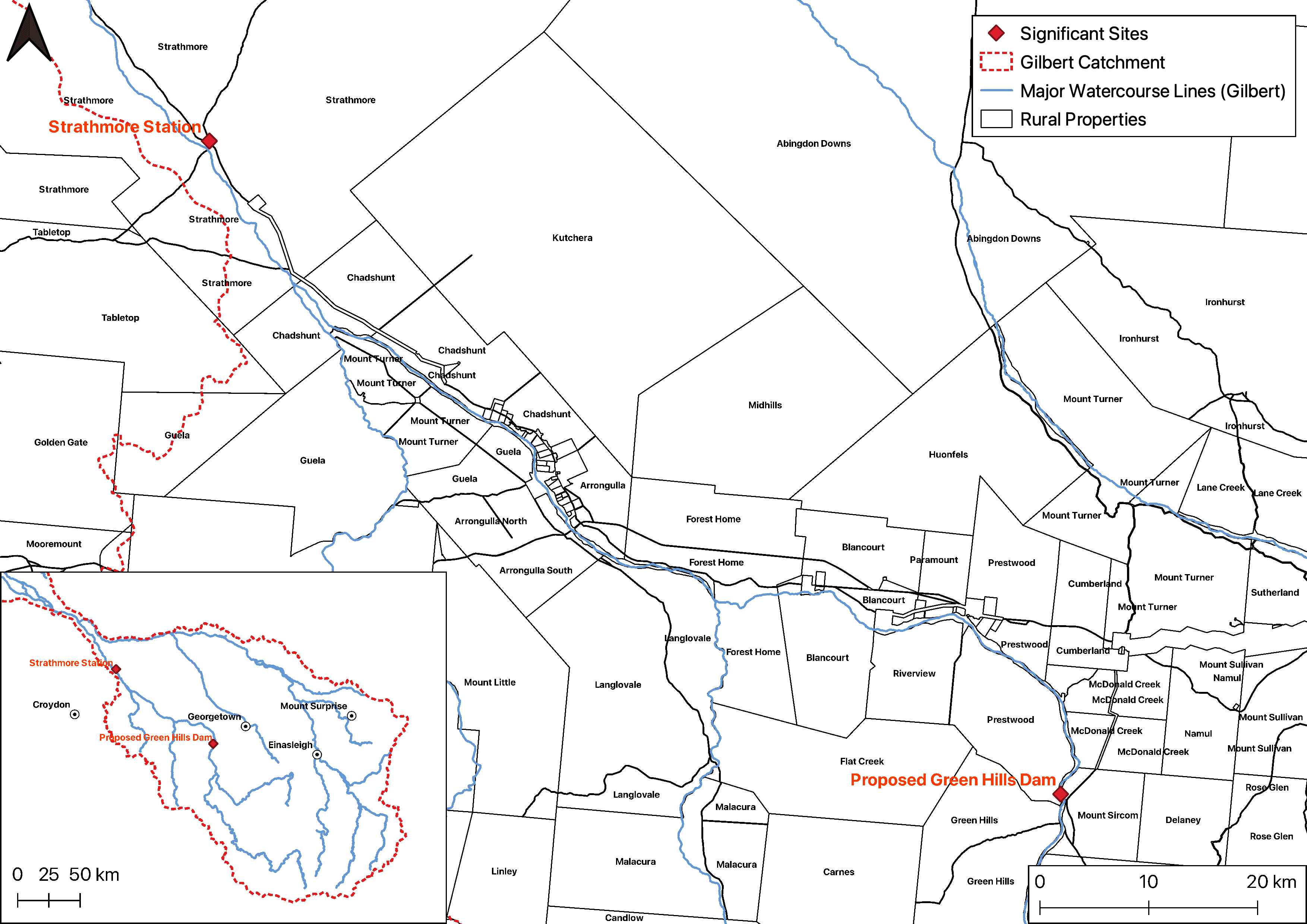
The Gilbert River Agricultural Precinct (GRAP) incorporates the properties along the Gilbert River between Green Hills and Strathmore Station. This area has been highlighted as having potential for broadscale irrigated agriculture based on soil properties and water availability, but development is currently limited to production of some horticultural crops and early investments in irrigated broadacre crops.
Read More
Proposed Green Hills Dam
The proposed Green Hills dam, an in-stream dam on the Gilbert River, was the focus of a detailed business case published in 2020. The dam, if built, would service the Gilbert River Agricultural Precinct, expanding irrigated agriculture in the area.
Read More
Groundwater
Groundwater is an important resource in the GRAP, with bores being used for stock and domestic use and a limited number of spear bores accessing water stored in the bedsands of the Gilbert River. Along with surface water, groundwater could be used to expand irrigated agriculture in the region.
Read More
Gulf Unallocated Water Release
Unallocated water to support irrigated agriculture and economic development opportunities in the Gilbert catchment.
Read More
Runoff
Runoff is fallen precipitation that moves across the land surface. Runoff can be estimated using models. Runoff in the Gilbert catchment is concentrated in the wet season and varies depending on the severity of the wet season.
Read More
Soils
Soils suitable for irrigation occur throughout the Gilbert catchment, particularly adjacent to the catchment's major rivers. Previous work has used both soil and climate data to gauge land suitability of numerous crops.
Read More
Stream network
A stream network describes how watercourses are connected.
Read More
Surface Water
Surface water in the north of Australia is influenced by the monsoonal climate, with many water bodies and watercourses being ephemeral. Those that are not ephemeral become refuges for flora and fauna in the dry season and/or watering points for cattle.
Read More
Vegetation Management
Development needs to ensure high value land is cared for. While landholders often care for the land themselves, government also imposes specific land clearing rules.
Read More
Vegetation
Vegetation, an assemblage of plant species, can be classified in many ways. How vegetation is classified has policy implications. Weeds are an issue in the northern Australia.
Read More
Water availability
In a monsoonal climate there is need to capture and store water in the wet season for use in the dry season. For year round irrigated agriculture to operate storing water is essential. However, altering flow patterns is not with impacts.
Read More
Water bodies
Water bodies flood in the wet and provide water into the dry, including farm dams, water holes, and wetlands and lakes.
Read More
Water budget
Water budgets in the region provide a means of understanding seasonal and inter-annual variation and potential water storage requirements.
Read More
Water infrastructure
Water infrastructure allows for the storage, diversion, supply and treatment of water. Water storage is limited in the Gilbert catchment compared to more agriculturally developed regions of Australia. Proposed developments and current water releases have a strong focus on progressing water infrastructure in the region.
Read More
Water management
Access to available surface water or groundwater is defined by the water source (surface water / groundwater) and the intended use of the water (e.g. stock and domestic, irrigation, prescribed activities).
Read More
Watershed / Catchment
A catchment is an area that collects water, defined by the areas topography. A catchment is made up of subcatchments, which are themselves made up of subcatchments. Many models depend on defining a catchment.
Read More
Weather
The climate in the Gilbert River has a distinct wet and dry season. On average, annual evapotranspiration more than doubles annual rainfall.
Read More